Credentis

Credentis is a framework for authorization validity in banking.

It shifts approval confidence from a transferable code to a live authorization event, where identity, intent, and transaction context must align before approval is trusted.

This is not a stronger delivery method for a familiar approval artifact. It is a different basis for determining whether authorization is valid.

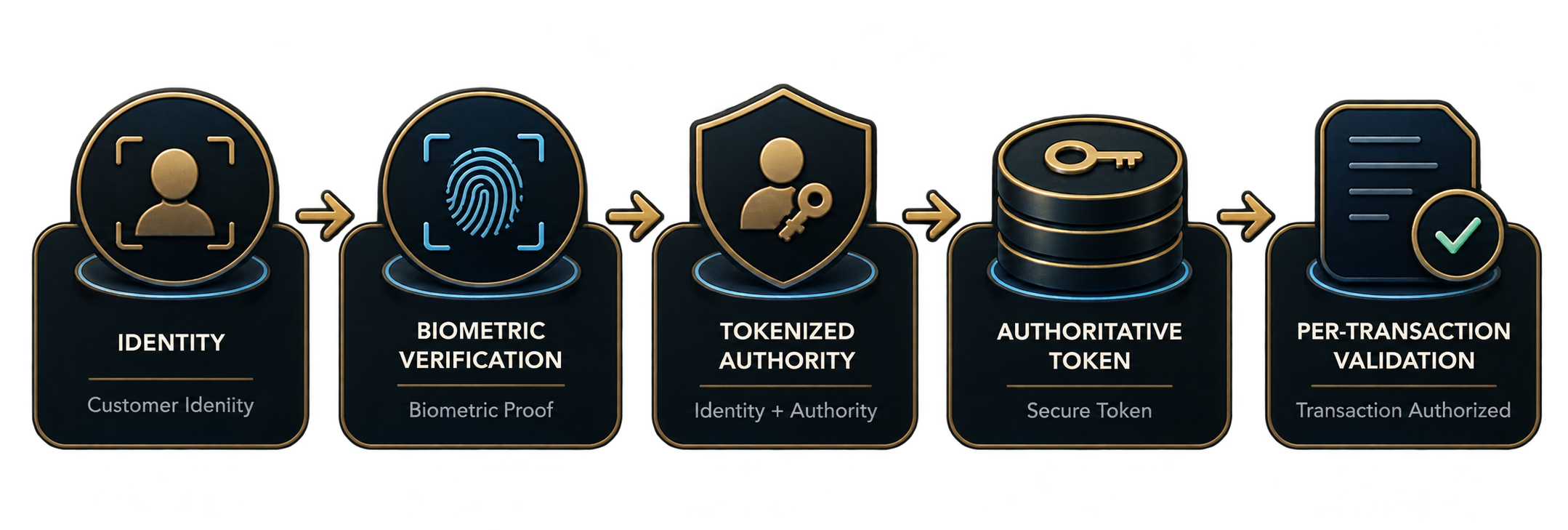
Identity, intent, and context visualized as one transaction-bound authorization system

What it is

A framework for determining whether approval is valid.

What it is not

Not another OTP product. Not a delivery-channel variation.

What changes

Approval confidence comes from live alignment of identity, intent, and context.

Why it matters

The category question is whether the institution can trust the authorization event itself.

Credentis changes the object of review by treating account access confidence as subordinate to a larger question: was this exact financial instruction validly authorized under the right control conditions?

Category distinction

Access confidence is not authorization validity.

Authentication may confirm account access, but it does not by itself determine whether the exact financial instruction was validly authorized.

Category distinction

Returned artifacts are not decisive by themselves.

A familiar artifact can still be replayed, relayed, or detached from the real approval context.

Category distinction

Channel separation alone does not complete the model.

Changing the route of delivery is not enough unless the institution also changes what it evaluates before approval is accepted.

The framework evaluates authorization validity as a control question, distinct from code-centered approval.

What the Framework Defines

The framework gives authorization a clearer object, boundary, and event model.

Transaction object

Specific transaction

Authorization is tied to the exact business event requiring approval.

Control environment

Distinct environment

Authorization does not occur inside the transaction-initiation environment.

Authorization event

Live authorization event

Authorization is captured within defined initiation, controlled exchange, and termination conditions.

Decisive conditions

Aligned conditions

Identity, Intent, and Context must coherently align for the exact transaction.

Control Architecture

Authorization becomes a controlled progression across distinct domains.

01Domain line

Transaction domain

The exact instruction, amount, beneficiary, and business context that define what is being authorized.

02Domain line

Authorization challenge domain

A transaction-bound challenge framed for the exact financial instruction rather than for generic account access.

03Domain line

Bounded authorization environment

Authorization occurs in a distinct environment so the event is not collapsed into the initiation surface.

04Domain line

Subscriber control domain

Identity continuity and deliberate intent are captured under controlled conditions for the live authorization event.

05Domain line

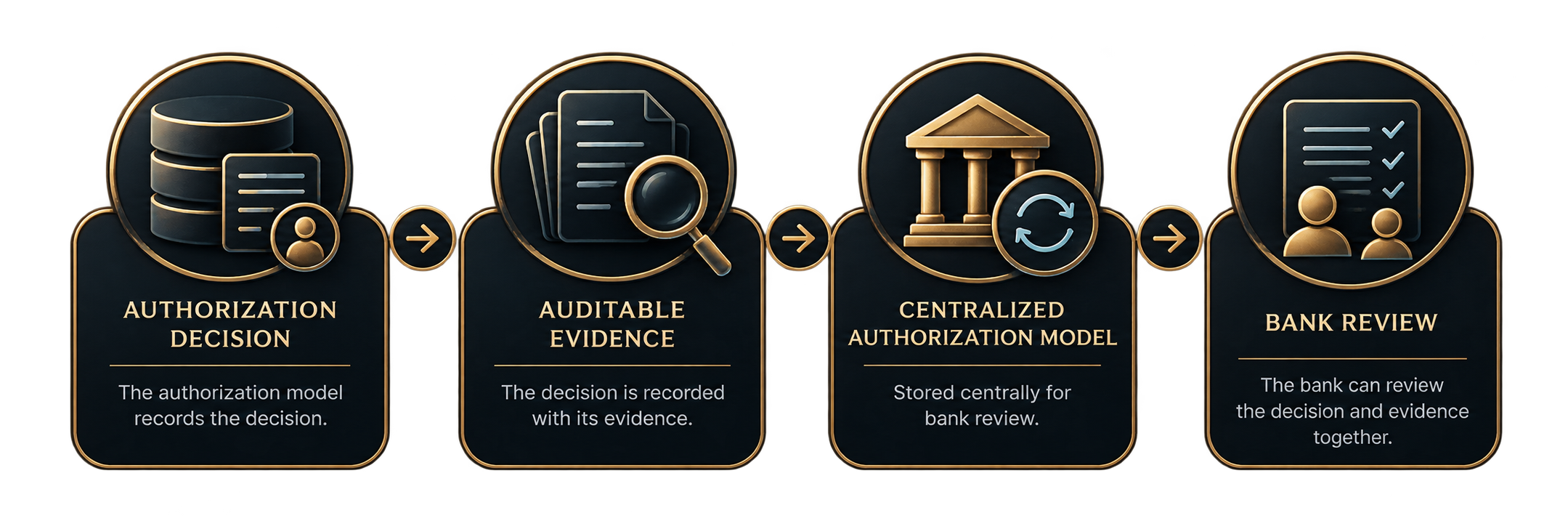
Decision and evidence domain

The institution receives a decision-ready output together with structured evidence for later review.

Threat Resistance

The framework resists weak authorization logic by changing what counts as decisive.

01

Resistance property

Separated authorization

Compromising the initiation environment alone does not yield valid authorization.

02

Resistance property

Exact-context binding

Approval must correspond to the real transaction, not to a detached action or generic prompt.

03

Resistance property

Non-replay decisiveness

Replayable proofs, detached codes, or transferable artifacts do not become decisive control.

04

Resistance property

Deliberate intent capture

Authorization must arise from a transaction-specific cognitive act, not passive continuation.

Security posture

Authorization failure is constrained before weak signals can become decisive.

Outcome boundary

Detached prompts, replayable proofs, and initiation-only compromise stop short of valid authorization.

Control effect

The decision event depends on coherent identity, exact transaction context, and deliberate subscriber action under controlled conditions.

Evidence and Review

Valid authorization must produce an institutional record that can be used later.

Durable records

Authorization events are preserved as reconstructable institutional records.

Operational review

Events can be reviewed for control quality, exceptions, and decision outcomes.

Dispute and fraud support

Evidence enables disciplined investigation and post-event analysis.

Supervisory readiness

The evidence-bearing approval model supports governance-grade traceability and assurance.

Where to go next

Start with the doctrine, then move into the operating realization.